
Guides · The fit question
Will a modern door fit a 1920s garage?
Often yes, sometimes with carpentry first, occasionally the honest answer is a different door than the one in the brochure. Mayfield's garages were built for 1920s cars by 1920s carpenters, and ninety years of settling later, "standard size" is a rumour. Here's the whole fit question, measurement by measurement.
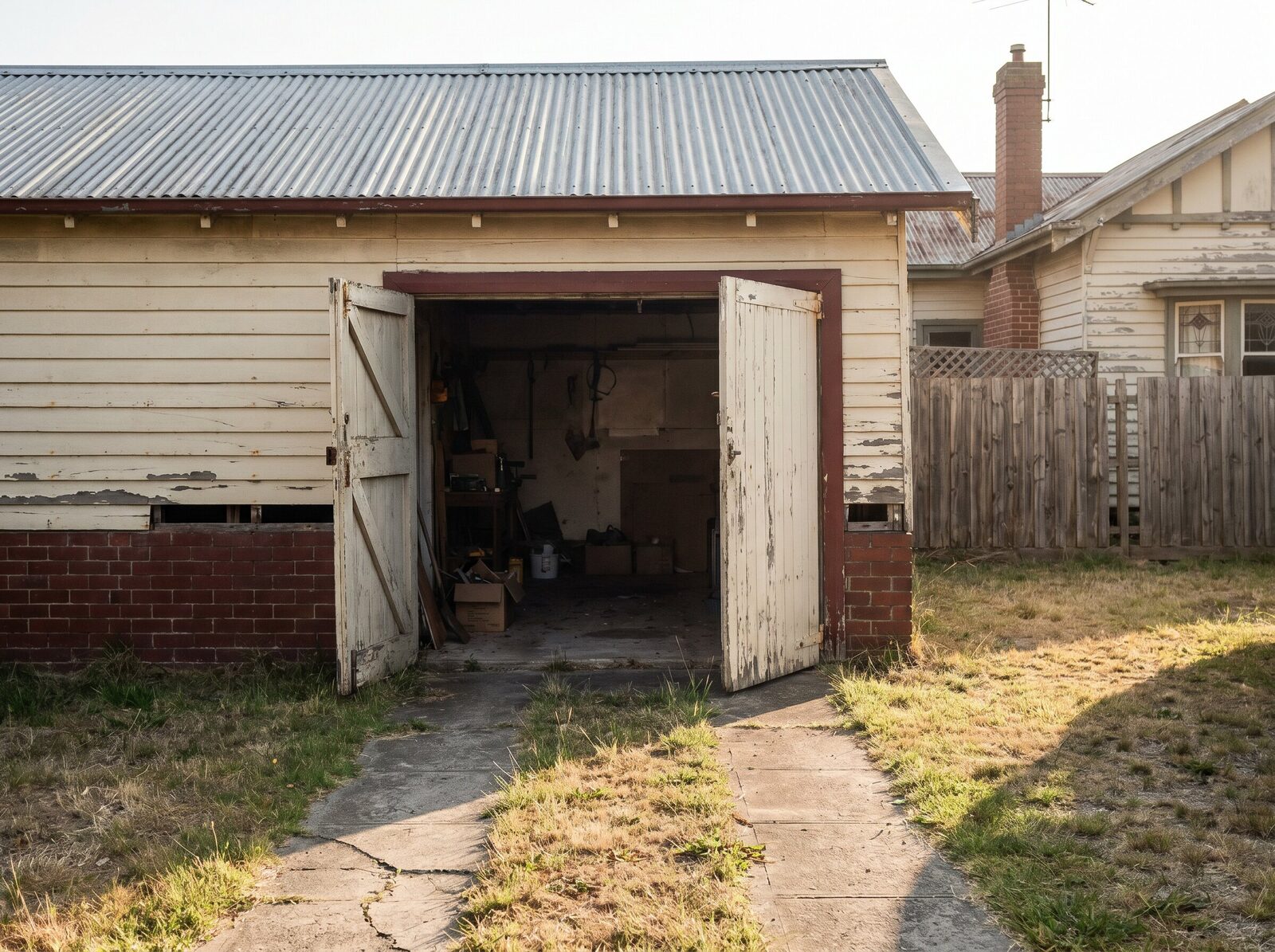
The four measurements that decide it
- Opening width and height. Interwar garages were sized for cars much smaller than today's. Many original openings are narrower and lower than modern standard doors expect; a door can often be made to suit, but nobody should order one before the tape has spoken.
- Headroom. The space between the top of the opening and the ceiling, inside. A sectional door typically wants roughly 300 to 400 mm for its tracks and curl; a roller drum can typically live in about 200 to 250 mm. Low-headroom track hardware exists for tight sectionals, and it's a real option, not a unicorn.
- Side room. Tracks, spring bar and drum brackets all want wall either side of the opening. Old single garages are often short of it on one side, which quietly rules door types in and out.
- The square of the frame. Timber frames move over ninety years. A new door hung in an out-of-square opening binds, wears fast and comes back off its track; sometimes the real first job is carpentry, and you should hear that before any door is ordered.
The three door types, compared honestly
| Criteria | Sectional | Roller | Tilt |
|---|---|---|---|
| Headroom needed | Typically ~300 to 400 mm (less with low-headroom track) | Typically ~200 to 250 mm; the least of the three | Moderate, plus outward swing clearance |
| Clearance in front | None; rises up and back overhead | None | Needs open space; the door swings outward as it opens |
| Insulation | Best of the three; solid panels seal well and insulated cores are available | Lower unless an insulated double-skin curtain is chosen | Moderate; a single solid panel, seal quality varies |
| Moving parts | The most: hinges, rollers, panels | Fewer | The fewest |
| Repairability | Spot-repairable panel by panel | Curtain usually repaired or replaced as a unit | A legacy type: mostly a repair market, new installs are rare |
| In an old Mayfield garage | Possible more often than assumed; the tracks need depth behind the opening | Usually the first candidate where headroom is tight | Usually what's being replaced; the outward swing fights tight drives |
Door type characteristics per the mechanism comparisons at PDS Garage Doors: roller vs sectional vs tilt.
The Mayfield extras
- Lane access. If the garage opens onto the rear lane, the delivery itself is part of the plan: door panels and rolled curtains need a way in, and the lane decides it. We check before ordering, not on delivery day.
- Lane-side security. While the door's being chosen, it's the moment to choose locking too: a lane door is a second front door nobody watches, and an opener that locks itself beats a latch from 1965.
- The streetscape. On a leadlight-and-weatherboard street, a door's profile and colour decide whether the house still looks like itself. Colour ranges like Colorbond give plenty of room to match the roof and fence; the match is offered as an on-site process, never guaranteed against weathered steel.
- The opener. An old opening that gets a new door usually gets its first opener too. Where mains wiring is involved, that part is done by a licensed electrician, as the law requires.
Measure first. Everything else is a guess wearing a brochure.
The twenty-second version of this page is the checker on the front page; the real version is a free measure and quote at your opening.
References
- PDS Garage Doors: roller vs sectional vs tilt, pros and cons. The mechanism comparison behind the table above, including typical headroom needs by type.
- Standards Australia: AS/NZS 60335.2.95. The safety standard for powered door drives; relevant the moment a new door gets an opener.
One form, two kinds of job
Tell us about the door
Broken this morning or being planned for next spring, it starts the same way: a few lines about the door and the block, and a straight answer back.